What this lets people do
A visual signal in the larger move from one-off AI media to generated worlds.
Streaming 3D reconstruction, long-horizon spatial memory, camera pose estimation, and browser-viewable scene understanding.
Streaming 3D foundation model
A visual signal in the larger move from one-off AI media to generated worlds.
 Streaming 3D foundation model
A visual signal in the larger move from one-off AI media to generated worlds.
Streaming 3D reconstruction, long-horizon spatial memory, camera pose estimation, and browser-viewable scene understanding.
Scene explainer
The page starts with the experience, then moves toward source-backed details.
 01
01First impression
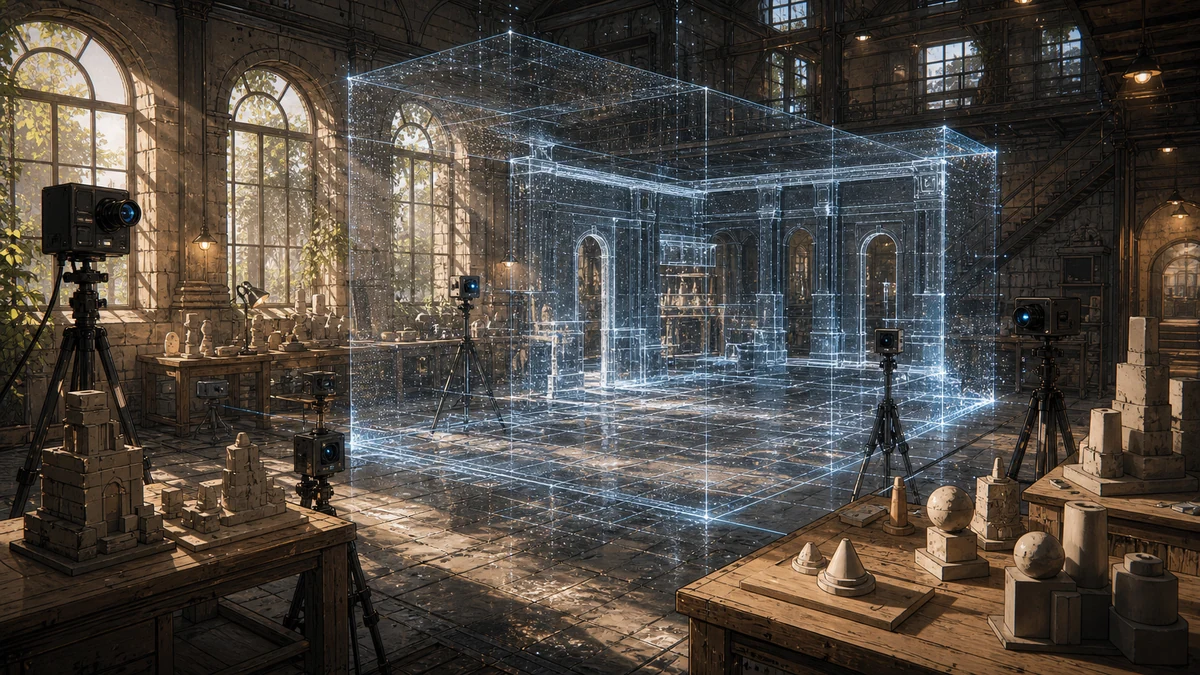
LingBot-Map is Robbyant's feed-forward 3D foundation model for streaming reconstruction from video sequences, now backed by a public benchmark pipeline for KITTI and Oxford Spires.
 02
02Capability
Useful bridge between world models and spatial computing because it tracks geometry and scene consistency over long sequences.
 03
03Boundary
LingBot-Map is a reconstruction model, not a generative world-creation product like Marble or HappyOyster.
Release signals
The company profile stays stable. These short signals explain what changed and point back to sources.
FAQ
Use these notes to keep model comments grounded in official sources and careful category boundaries.
The site tracks systems that model environments, actions, spatial structure, or persistent simulated state. Pure text chatbots and ordinary video generators are only included when they provide a clear bridge toward interactive or physical world modeling.
Video models are included only when they help explain the path from generated clips to controllable spaces, physics-aware prediction, or agent-ready simulation. The site keeps that distinction explicit so video generation is not overstated as a finished world simulator.
Primary sources carry the most weight: official product pages, research posts, papers, documentation, code repositories, and company announcements. Secondary media can be referenced, but it stays labeled as reported or adjacent unless independently confirmed.
Useful comments add source links, corrections, release-status notes, comparison questions, or concrete reader context. Comments are public immediately, so readers should avoid private information and unsupported promotional claims.
Discussion
Add source-backed corrections, questions, or notes for this page.
No comments yet. Start with a source note or a question for future coverage.